Back in October I noted the kick-off meeting for the Supreme Court Children's Commission - Education Committee. That group and its many components and staff have been working away at the educational challenges faced by foster kids, and I enjoyed an update on that work today; a lot is happening both in Texas and nationally to improve the way these different systems interact with each other so that the kids can be kept safe, but also receive the education they need and are entitled to. For example, in early November, the federal Department of Education and the Administration for Children and Families are co-hosting an event that will highlight and spur more collaboration between child welfare, education and the courts.
Here in Texas, Chief Justice Jefferson's 2011 State of the Judiciary address has helped keep me focused on issues of juvenile justice. We memorialized his interest in these topics for the 82nd Legislature on a Children's Commission webpage, and I believe it is safe to say that his interest is starting to catch on with other chief justices around the country, as he enjoys the bully pulpit of chairing the Conference of Chief Justices this year.
One result of his interest is an upcoming event that readers will want to note. On the morning of July 19th, Chief Justice Jefferson and Judge Jeanne Meurer will host an event in the Supreme Court Courtroom, the presentation of a massive new report, by the Council of State Governments Justice Center. The report uses data only available in Texas to track the school disciplinary treatment of almost 1 million Texas middle school children, delving deeper into the relationships between suspension, expulsion, and involvement in the juvenile justice system. If you can't attend in person, as with the Court's oral arguments you can view a webcast, courtesy of St. Mary's University School of Law.
Friday, June 24, 2011


Wednesday, June 8, 2011
The Unrepresented
The unrepresented, or self represented as we perhaps mis-name them, are a topic of high interest, as previously mentioned. I was recently asked what we know about the volume of people in the courts attempting to handle their own legal problems (which all of us lawyers think is a very bad idea). Here is some of what I learned.
We do not (yet) have good systemic data on the extent of pro se/self represented litigation in Texas, and the National Center for State Courts advises that no one else has it either (which still surprised me, as many states have more consolidated case management systems capable of gathering better data than we get); what NCSC says is “lots of anecdotal evidence but no consistent data.” Richard Zorza, a national consultant on these issues, agrees that the data is chaotic. In lieu of better data, he has previously cited the following information in the 2009 Future Trends in State Courts report that NCSC produces (see http://www.ncsconline.org/WC/Publications/Trends/Archives.html):
Last week a judge estimated that pro se divorces run about 45% of all his divorce filings. I have recent data point from another Texas county that squarely supports this estimate. So, applying that 45% estimate as a statewide assumption for that case type, there were approximately 61,000 pro se divorces in 2010. If you make the same 45% assumption for all other family law matters, add another 112,000 to that. (And by the way, divorces in Texas are declining per capita over the last 20 years, a 7% increase in filings over that time, despite 43% population growth.)
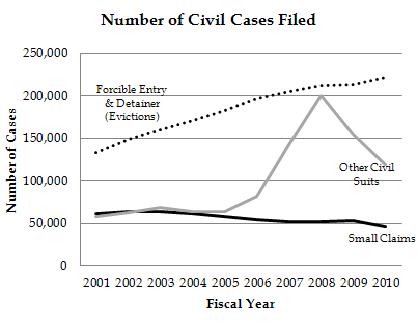
We do have one area of very good statewide data on pro se litigation, in small claims courts, which are pro se by definition. Filings are down some over time, and certainly down per capita. Evictions may be a countervailing trend but we don’t have good data on pro se representation. My counterparts in California advise that 90% of tenants go unrepresented in their courts.

We do not (yet) have good systemic data on the extent of pro se/self represented litigation in Texas, and the National Center for State Courts advises that no one else has it either (which still surprised me, as many states have more consolidated case management systems capable of gathering better data than we get); what NCSC says is “lots of anecdotal evidence but no consistent data.” Richard Zorza, a national consultant on these issues, agrees that the data is chaotic. In lieu of better data, he has previously cited the following information in the 2009 Future Trends in State Courts report that NCSC produces (see http://www.ncsconline.org/WC/Publications/Trends/Archives.html):
It is no surprise that the economic crisis is dramatically impacting both the numbers and proportion of self-represented litigants. In a 2009 survey conducted by the Self-Represented Litigation Network, between 50 and 60 percent of judges reported higher caseloads and a higher percentage of the self-represented as a result of the crisis (with many reporting both). Only 27 percent reported no impact, and many of those were criminal-court judges (see figure below). Some courts and judges are also seeing many more middle-class litigants coming to court without lawyers. Some of these litigants are reported to have higher expectations of how they will be treated and to be more prone to frustration with the situation and how courts are managing it.
We do have one area of very good statewide data on pro se litigation, in small claims courts, which are pro se by definition. Filings are down some over time, and certainly down per capita. Evictions may be a countervailing trend but we don’t have good data on pro se representation. My counterparts in California advise that 90% of tenants go unrepresented in their courts.
Sunday, May 29, 2011
Funding Crisis
It looks like the state budget will not cover fundamental legal needs identified by the leadership of the Judicial Branch. During session I have refrained from using the blog for commentary on bills, except to explain the many bills that would raise criminal court costs. At this point - apparently too late - I am obliged to at least point out the irony of what has happened.
Basic Civil Legal Services, the fund supporting the bare-bones infrastructure for fundamental legal services, ended up $20 million short. The Indigent Defense Fund, supporting county efforts to provide constitutionally required defense in criminal cases, ended up $8.6 million short. Both programs already dramatically underserve their target populations due to budgetary decisions, including the continued large-scale redirection of revenue generated from the Judicial Branch.
The Legislative Budget Board reports that the Judicial Branch generated $185 million more in revenue (through criminal court costs and civil filing fees, much more the former), than the Legislature appropriated for the Judicial Branch, last biennium. We brought this information to the forefront in the appropriations process, and in an ideal world the response would have been to reallocate funds already generated to meet the critical needs identified by the leadership of the Judicial Branch. In the world we live in, holding our noses, we proposed several ways to raise the additional revenue those critical needs require, and it was only yesterday that we learned that the Legislature ultimately failed to adopt them - a $5 additional cost in criminal cases (added to $98 currently), and a $10 increase in civil filing fees (added to $5 or $10 current fees, depending on case type).
Caselaw suggests that civil fees cannot be redirected to support functions outside the courts, under the Open Courts doctrine. The same result holds true in criminal cases under the Separation of Powers doctrine. For obvious reasons the court system and its individual actors cannot be expected to generate revenue to ensure their own existence. But by the same token, the Legislature must address the mismatch between court revenue generated and, at a minimum, the critical needs identified by our leadership. Having watched the appropriations process closely on both sides during session, I am honestly impressed by the people who are making these difficult decisions. But I am bitterly disappointed and worried about this particular decision.
Basic Civil Legal Services, the fund supporting the bare-bones infrastructure for fundamental legal services, ended up $20 million short. The Indigent Defense Fund, supporting county efforts to provide constitutionally required defense in criminal cases, ended up $8.6 million short. Both programs already dramatically underserve their target populations due to budgetary decisions, including the continued large-scale redirection of revenue generated from the Judicial Branch.
The Legislative Budget Board reports that the Judicial Branch generated $185 million more in revenue (through criminal court costs and civil filing fees, much more the former), than the Legislature appropriated for the Judicial Branch, last biennium. We brought this information to the forefront in the appropriations process, and in an ideal world the response would have been to reallocate funds already generated to meet the critical needs identified by the leadership of the Judicial Branch. In the world we live in, holding our noses, we proposed several ways to raise the additional revenue those critical needs require, and it was only yesterday that we learned that the Legislature ultimately failed to adopt them - a $5 additional cost in criminal cases (added to $98 currently), and a $10 increase in civil filing fees (added to $5 or $10 current fees, depending on case type).
Caselaw suggests that civil fees cannot be redirected to support functions outside the courts, under the Open Courts doctrine. The same result holds true in criminal cases under the Separation of Powers doctrine. For obvious reasons the court system and its individual actors cannot be expected to generate revenue to ensure their own existence. But by the same token, the Legislature must address the mismatch between court revenue generated and, at a minimum, the critical needs identified by our leadership. Having watched the appropriations process closely on both sides during session, I am honestly impressed by the people who are making these difficult decisions. But I am bitterly disappointed and worried about this particular decision.
Thursday, April 21, 2011
eFiling Request for Information
OCA, on behalf of the Judicial Committee on Information Technology, has just released a request for information for a statewide eFiling system. Here is an excerpt and below are links for the interested:
JCIT is, therefore, considering developing a partnership with a company with proven electronic filing experience to construct, deploy, and operate a public facing Internet electronic filing portal that integrates with court automation systems and comports with JCIT’s directives. JCIT is considering seeking a partner that can:
• Provide a robust Electronic Filing Manager that can support multiple, unique jurisdictions and integrate into the courts case management systems (that use the NIEM or OASIS Legal XML standard).
• Comply with national electronic filing standards (ECF) and any extensions required to support the initiative.
• Deploy and support an easy to use Internet-based portal that supports both free-form pleadings and form based filings. This includes ad hoc reporting for the filer to review previous submissions.
• Market the system to courts to increase participation.
• Provide support to users of the system in the form of documentation and help-desk (call center) support.
• Collect and distribute all fees using a PCI compliant method.
• Provide assistance to courts when needed to ensure that eFiling can be reconciled with financial and case management systems.
• Provide other value-added services to users (e.g. Intelligent/Assistive Forms, Public Access to Court Documents, Application Development for Specialized Filer Needs)
Link to the RFI: http://www.courts.state.tx.us/jcit/Efiling/pdf/eFilingRFI.pdf
Link to the page where we’ll post answers to any questions: http://www.courts.state.tx.us/jcit/Efiling/eFilingRFI.asp
JCIT is, therefore, considering developing a partnership with a company with proven electronic filing experience to construct, deploy, and operate a public facing Internet electronic filing portal that integrates with court automation systems and comports with JCIT’s directives. JCIT is considering seeking a partner that can:
• Provide a robust Electronic Filing Manager that can support multiple, unique jurisdictions and integrate into the courts case management systems (that use the NIEM or OASIS Legal XML standard).
• Comply with national electronic filing standards (ECF) and any extensions required to support the initiative.
• Deploy and support an easy to use Internet-based portal that supports both free-form pleadings and form based filings. This includes ad hoc reporting for the filer to review previous submissions.
• Market the system to courts to increase participation.
• Provide support to users of the system in the form of documentation and help-desk (call center) support.
• Collect and distribute all fees using a PCI compliant method.
• Provide assistance to courts when needed to ensure that eFiling can be reconciled with financial and case management systems.
• Provide other value-added services to users (e.g. Intelligent/Assistive Forms, Public Access to Court Documents, Application Development for Specialized Filer Needs)
Link to the RFI: http://www.courts.state.tx.us/jcit/Efiling/pdf/eFilingRFI.pdf
Link to the page where we’ll post answers to any questions: http://www.courts.state.tx.us/jcit/Efiling/eFilingRFI.asp
Monday, March 21, 2011
Costs on Conviction
Ted Wood at OCA helps us all make sense of filing fees and court costs; he maintains a body of manuals for clerks on our page of Publications & Forms. Below I am providing his guide to bills that would raise fees upon conviction of various offenses.
Speeding
A typical speeding conviction in municipal court results in $97.10 in mandatory court costs. In justice court the costs are a dollar more. These court costs do not include fines. (The amount of the fine is up to the judge or jury and can range from $1 to $200.)
Seven bills would serve to increase court costs in speeding cases. If all seven pass, court costs will rise $39 to $137.10 in most justice courts and $32 to $129.10 in most municipal courts:
HB 258 $15 increase in “state traffic fine” (actually a court cost) from $30 to $45.
2/3 of revenue to State’s General Fund; 1/3 to State for trauma and emergency medical services.
HB 331 $1 new cost in municipal courts. Money used for interpreter services, mental health and counseling, ADA modifications, attorney fees for indigent defendants, and judicial education.
HB 395 $5 increase in courthouse security fee (from $4 to $9) and municipal court building security fee ($3 to $8). Money used for court security. HB 777, SB 606, HB 904, & SB 1677 are similar.
HB 1261 $1 increase in municipal court technology fund (from $4 to $5).
HB 2344 $2 new cost in justice courts. money directed to county law enforcement technology fund.
SB 607 $7 new cost in counties with at least 100,000 population (except for Harris County which already can assess this cost). Counties choose whether to impose the cost – most probably will. Money stays with county - no limitations on use.
SB 726 $10 new cost in municipal and justice courts (in cases other than parking and pedestrian cases). Money directed to State “Judicial Access and Improvement Account” to support civil legal services for indigents, indigent defense, state court e-filing, and the state law library.
HB 2174 is an alternative to SB 726 that would direct $5 instead of $10 to the same places.
DWI
A typical Class B Misdemeanor DWI charge will set a person back $397.10 for court costs alone. A fine can be as much as $2,000 on top of the court costs. And a defendant must generally pay a “surcharge” of $1,000 per year for three years to keep his or her driver’s license. (Several bills have been filed that would eliminate the surcharges.)
Two bills would add $50 to DWI court costs. If both bills pass, the court costs for a DWI would increase from $397.10 to $447.10.
HB 395 has already been mentioned in the discussion of speeding cases above. The second bill is:
HB 933 $45 new court cost assessed in DWI and certain other intoxication cases. Money retained by county for certified breath alcohol testing program.
Felony Property Offenses (Arson, Burglary, Robbery, Theft)
Current court costs total $214. Any fine assessed is on top of the court costs.
Three bills would add $45 to the court costs for a new total of $259. The three bills include the previously-mentioned HB 395. The two other bills are:
HB 2065 $15 new court cost on property offenses such as arson, robbery, burglary, and theft. Money would be go to both the State and county for pretrial victim- offender mediation programs.
SB 1616 $25 new court cost on all felonies. Money would go to State’s “biological evidence preservation account.”
Drug Offenses
Court costs for a typical felony drug offense already total $294. This does not include the amount of any fine that may be assessed.
There are three bills that would nearly double the amount of the court costs in this type of case. The new court cost total would be $524, a $230 increase.
HB 395 has been discussed previously as has SB 1616.
SB 994 $200 new court cost on any felony drug offense. Money would be directed to the State for general law enforcement purposes.
Compelling Prostitution
Court costs for this offense are already quite high - $484. If four relevant bills pass, that amount will
climb $140 higher to $624, a 29% increase.
HB 395 and SB 1616 have been mentioned before. The following two bills have not yet been
mentioned:
HB 3746 $10 new court cost on crimes for which the defendant is required to register as a sex offender. Money goes to State for deposit in the “Internet Crimes Against Children Fund” which would be used to support the administration of the activities of three existing Internet Crimes Against Children task forces that are operated by the attorney general and other law enforcement entities. SB 1843 does the same thing.
HB 2014 $100 new court cost on offense of compelling prostitution or trafficking of persons. 50% of money would be retained by county for deposit in a “trafficking of persons and compelling prostitution prevention fund”; 50% of money to State for unspecified purposes]
Speeding
A typical speeding conviction in municipal court results in $97.10 in mandatory court costs. In justice court the costs are a dollar more. These court costs do not include fines. (The amount of the fine is up to the judge or jury and can range from $1 to $200.)
Seven bills would serve to increase court costs in speeding cases. If all seven pass, court costs will rise $39 to $137.10 in most justice courts and $32 to $129.10 in most municipal courts:
HB 258 $15 increase in “state traffic fine” (actually a court cost) from $30 to $45.
2/3 of revenue to State’s General Fund; 1/3 to State for trauma and emergency medical services.
HB 331 $1 new cost in municipal courts. Money used for interpreter services, mental health and counseling, ADA modifications, attorney fees for indigent defendants, and judicial education.
HB 395 $5 increase in courthouse security fee (from $4 to $9) and municipal court building security fee ($3 to $8). Money used for court security. HB 777, SB 606, HB 904, & SB 1677 are similar.
HB 1261 $1 increase in municipal court technology fund (from $4 to $5).
HB 2344 $2 new cost in justice courts. money directed to county law enforcement technology fund.
SB 607 $7 new cost in counties with at least 100,000 population (except for Harris County which already can assess this cost). Counties choose whether to impose the cost – most probably will. Money stays with county - no limitations on use.
SB 726 $10 new cost in municipal and justice courts (in cases other than parking and pedestrian cases). Money directed to State “Judicial Access and Improvement Account” to support civil legal services for indigents, indigent defense, state court e-filing, and the state law library.
HB 2174 is an alternative to SB 726 that would direct $5 instead of $10 to the same places.
DWI
A typical Class B Misdemeanor DWI charge will set a person back $397.10 for court costs alone. A fine can be as much as $2,000 on top of the court costs. And a defendant must generally pay a “surcharge” of $1,000 per year for three years to keep his or her driver’s license. (Several bills have been filed that would eliminate the surcharges.)
Two bills would add $50 to DWI court costs. If both bills pass, the court costs for a DWI would increase from $397.10 to $447.10.
HB 395 has already been mentioned in the discussion of speeding cases above. The second bill is:
HB 933 $45 new court cost assessed in DWI and certain other intoxication cases. Money retained by county for certified breath alcohol testing program.
Felony Property Offenses (Arson, Burglary, Robbery, Theft)
Current court costs total $214. Any fine assessed is on top of the court costs.
Three bills would add $45 to the court costs for a new total of $259. The three bills include the previously-mentioned HB 395. The two other bills are:
HB 2065 $15 new court cost on property offenses such as arson, robbery, burglary, and theft. Money would be go to both the State and county for pretrial victim- offender mediation programs.
SB 1616 $25 new court cost on all felonies. Money would go to State’s “biological evidence preservation account.”
Drug Offenses
Court costs for a typical felony drug offense already total $294. This does not include the amount of any fine that may be assessed.
There are three bills that would nearly double the amount of the court costs in this type of case. The new court cost total would be $524, a $230 increase.
HB 395 has been discussed previously as has SB 1616.
SB 994 $200 new court cost on any felony drug offense. Money would be directed to the State for general law enforcement purposes.
Compelling Prostitution
Court costs for this offense are already quite high - $484. If four relevant bills pass, that amount will
climb $140 higher to $624, a 29% increase.
HB 395 and SB 1616 have been mentioned before. The following two bills have not yet been
mentioned:
HB 3746 $10 new court cost on crimes for which the defendant is required to register as a sex offender. Money goes to State for deposit in the “Internet Crimes Against Children Fund” which would be used to support the administration of the activities of three existing Internet Crimes Against Children task forces that are operated by the attorney general and other law enforcement entities. SB 1843 does the same thing.
HB 2014 $100 new court cost on offense of compelling prostitution or trafficking of persons. 50% of money would be retained by county for deposit in a “trafficking of persons and compelling prostitution prevention fund”; 50% of money to State for unspecified purposes]
Thursday, March 10, 2011
Performance Guidelines for Non-Capital Criminal Defense Representation
I am happy to serve on the State Bar's Standing Committee on Legal Services to the Poor in Criminal Matters. That committee has developed and just released a digestible but comprehensive guide to criminal practice in Texas state court from the time of initial representation in trial-level proceedings to the exhaustion of direct review before the Court of Criminal Appeals. The guidelines seek to encourage defense attorneys to perform to a high standard of representation and to promote professionalism in the representation of indigent defendants. The committee previously published Guidelines and Standards for Texas Capital Counsel and is on the verge of releasing a brochure for distribution statewide, to provide information to defendants considering representing themselves in misdemeanor criminal cases.
Friday, January 28, 2011
Disproportionality in Texas Systems

To start off the blogging in 2011, this chart speaks for itself, but a little more explanation. . . Racial disproportionality, specifically the impact of being African-American, pervades the child welfare, school discipline, juvenile justice, and criminal justice systems. For every bad outcome, from having a child removed from the home to being on death row, African Americans are represented significantly more than they are represented in our state population, and the exact reverse is true for Whites.
Data Sources:
• State Population: Estimate of the Population by Age, Sex, and Race/Ethnicity for July 1, 2009 for State of Texas, Texas State Data Center, http://txsdc.utsa.edu/tpepp/2009ASREstimates/alldata.pdf.
• FY 2009 CPS Data: Texas Department of Family and Protective Services, Data Book 2009, http://www.dfps.state.tx.us/About/Data_Books_and_Annual_Reports/2009/default.asp.
• Students Expelled 2008–2009, Mandatory and Discretionary Expulsions 2007–2008: Texas’ School-to-Prison Pipeline: School Expulsion The Path from Lockout to Dropout, Texas Appleseed, 2010, http://www.texasappleseed.net/index.php?option=com_docman&task=doc_download&gid=380&Itemid.
• Juvenile Justice Data: The State of Juvenile Probation Activity in Texas—Calendar Year 2008, http://www.tjpc.state.tx.us/publications/reports/RPTSTAT2008.pdf, published July 2010.
• Prison/State Jail Population: TDCJ On Hand as of August 31, 2009: Texas Department of Criminal Justice, Fiscal Year 2009 Statistical Report, http://www.tdcj.state.tx.us/publications/executive/Statistical_Report_FY09.pdf.
• Felony Revocations: FY 2010 Statewide Felony Revocations to Texas Department of Criminal Justice, data received from Texas Department of Criminal Justice, December 27, 2010.
• Drug Arrests: Arrest Data by Race, 2009 Crime in Texas, http://www.txdps.state.tx.us/administration/crime_records/pages/crimestatistics.htm
• Death Row Offenders: Gender and Racial Statistics of Death Row Offenders, http://www.tdcj.state.tx.us/stat/racial.htm, last updated November 22, 2010.
Subscribe to:
Posts (Atom)